

Child support is a common area of dispute in divorce and family law. While not every family law case in Plainfield, Joliet and Shorewood (IL) involves child support, whenever minor children are concerned, it is often a main issue that courts and attorneys must address alongside child custody and parenting time.
The following provides answers and insight to common questions and items in cases including child support.
What Is Child Support?
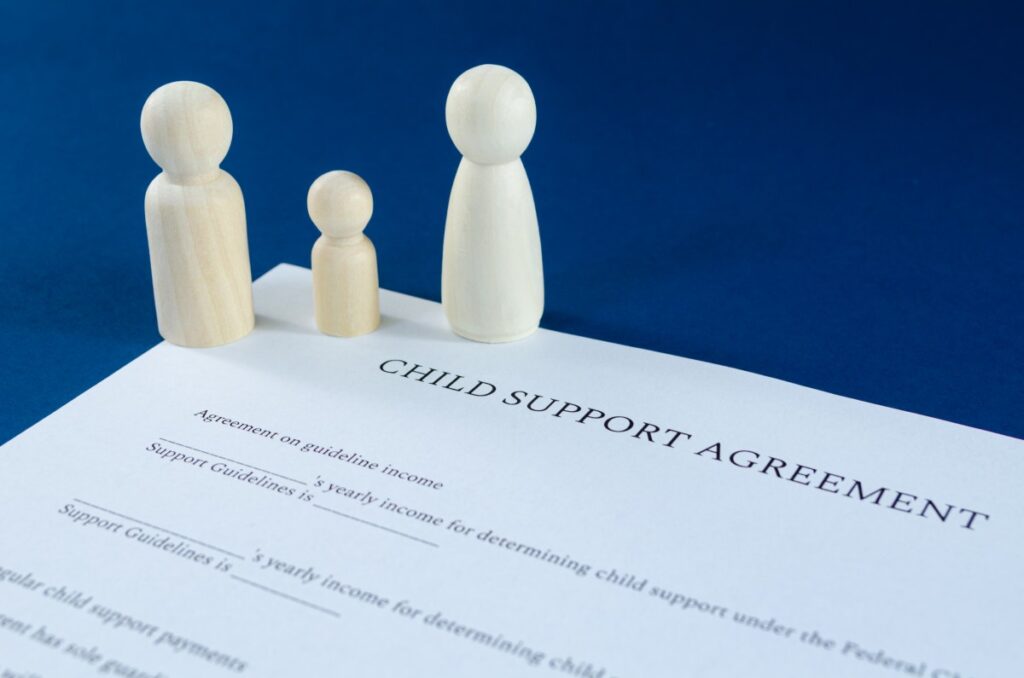
Child support is when one parent is required by court order to send regular payments to the other parent to help cover basic needs for their minor children.
Who Has to Pay Child Support?
Who will be ordered to pay child support depends on how the parenting-time schedule is arranged.
If the children reside with one parent most of the time, the other parent can be ordered to pay child support.
If the parents have an equal parenting-time schedule with the children, and one parent has a higher income than the other, the higher-earning parent could be ordered to pay child support.
How Child Support Is Calculated
The state of Illinois has a child support formula that considers both parents’ incomes. The combined gross incomes and the number of children are entered into the formula to determine the child support payment.
If the parent receiving the child support has a low income, and the parent paying child support has a high income, then the child support calculation will be higher.
If the parent receiving child support has higher income, and the paying parent has lower income, then child support will be lower.
Parents often disagree as to how to set their incomes for child support calculations because their income levels determine the amount of child support that will be paid. The parent receiving child support will often try to have their income set as low as possible. He or she also will tend to argue that the other parent’s income should be set as high as possible. The aim is to maximize the child support payment.
Conversely, the parent paying child support will try to calculate their income as low as possible while arguing that the other parent’s income should be set as high as possible. The goal is to minimize the child support payment.
Here’s an example:
Let’s say Shawn and Christine have separated. Their children live with Christine in Shorewood most of the time. Shawn, who now resides in Joliet, will have to pay child support.
Christine works part-time at minimum wage. Shawn works more than 40 hours a week, including overtime pay.
Christine might argue her income should be calculated by her average of part-time hours worked and Shawn’s income should be averaged to include his overtime.
Shawn, on the other hand, will argue that his overtime should not be included because he’s not always certain to have overtime hours. He also argues that Christine’s income should be set to full-time.
In Shawn’s scenario, Christine might counter that she cannot work full-time because a medical condition prevents her from doing so. Plus, one child’s special health needs require her to spend more time caring for that child.
As we can see, various factors might be present in determining child support. A judge’s decision will depend on the facts of each case.
To help estimate how much support payments might be each month, Illinois offers a free online child support calculator.
How to Request Child Support
The process usually starts by filing two petitions with the court:
- a petition to establish paternity, asking that the court officially establish each parent as biological to the children
- a petition requesting child support
Sometimes these are combined into one petition.
If the parents are married, and the children were born during the marriage, the parties will be presumed to be the children’s biological parents. If one parent files for divorce, then usually only the petition to establish child support is filed in addition to the petition requesting the divorce.
After a parent files the court petitions, and the court opens a new case in its system, the other parent must receive official notice that the case has been filed. This is often achieved by having him or her served with a copy of the petition using a process server.
If the other parent voluntarily registers onto the case by filing an appearance form with the court, they will not have to be served with the documents. If that person hires an attorney, the attorney will register onto the case.
At some point the court will enter a judgment establishing the parties as the children’s biological parents. After that occurs, child support can be ordered. Note again that this step would likely not be followed if the parents are married and getting divorced.
Child Support: Finances in a Divorce
Both parents will be required to exchange financial information. This can be as simple as providing their last three pay stubs and most recent W-2’s and tax returns.
It also can be more complex, such as examining bank records and averaging the last three years of income. Some cases can become further lengthened and involved when one party is not willing to truthfully disclose all income.
If a party is not working or not working full-time, the judge can order that person to start applying for jobs to maximize their income. In some instances, if someone is voluntarily underemployed, the judge can impute that parent’s income to a higher amount and calculate child support as if their income was that amount, even though the parent is not currently earning that much.
After the parents’ incomes are established, child support is calculated and ordered. It is often stated as a monthly rate or one matching the paying parent’s pay cycle (e.g. weekly, every other week, twice per month).
How Child Support Is Paid
Depending on the requirements of the court order establishing child support, payments can be fulfilled in the following ways.
Made directly from one parent to the other
This can be an efficient, quick method for sending and receiving payments. However, it is important that the payments be well documented so there is proof that they were made.
For example, if child support is paid in cash and the parties do not document the payments, such as by email or text, there will be no evidence of receipt.
If child support is paid by check or electronic transfer, the payor can document the payments by writing “child support” in the memo line or notes.
Made directly to the state disbursement unit
After child support is ordered in a court case, the court orders can be sent to the Illinois State Disbursement Unit (SDU) for processing of the payments.
The SDU will create a file in their system for that specific case involving child support. The paying parent will then send the payments directly to the SDU, which will then process them and send them to the other parent.
The other parent can request the payments be directly deposited by the SDU into a specified bank account. He or she also can receive payment-receipt updates by email or text.
Managing child support payments through the SDU can benefit both parents because the SDU will track all payments they receive and process.
Withheld from a payor’s paychecks
With this payment method, the payor’s employer will receive copies of the court orders and instructions to withhold the child support payments from the payor’s paychecks. The employer will be required to forward the payments to the SDU, which will send the payments to the payee.
If a payee requests that child support be paid through income withholding, the judge will often grant this request and require this method of payment.
How Long Does Child Support Last?
Child support is usually required until the child turns 18 or graduates high school, whichever occurs later. At this point, the child is considered to be “emancipated.”
If the child is still attending high school after turning 18, the court will typically not require that child support be paid after the child turns 19.
In a situation where the child has special needs and has not graduated high school after the age of 19, the court could require that child support payments continue. However, the child support rate could be affected if the parent who mainly resides with the child receives Social Security payments for the child. If the parent with the majority of parenting time has not applied for Social Security benefits, the other parent can request that the court order them to do so.
Can Child Support Payments Be Changed?
Depending on the circumstances, either parent can request that the child support payment be modified. In this event, Illinois law requires that the person requesting the modification show that a substantial change in circumstances occurred since the last court order was entered.
The new child support payment amount can be made retroactive to the date the court petition or motion was filed.
Child Support Attorney Near Me: Contact
Navarro Family Law serves Plainfield, Shorewood and Joliet (IL) as a family law attorney for fair representation and equitable distribution of assets under established Illinois law.
This firm supports clients in diverse situations with experienced legal advice and courtroom experience. Navarro Family Law further takes pride in providing detailed explanations regarding your rights and responsibilities in a divorce, including child custody and child support.
If you would like to further discuss child support law in Plainfield, Shorewood or Joliet or inquire about case representation with a “child support lawyer near me,” call or text (815) 207-9570 today.